Beer Pong Tournament Club Event: Sign-ups, Schedule, Age Limits
Jump to the FAQAt a club or community event the beer pong tournament is one act among brass bands, cake stalls and a raffle. It has a slot on the schedule, a time window, a helper looking after it — and it should appeal to more than the twenty people who play every weekend anyway. This article shows how to run a beer pong tournament club event without somebody being stuck at the stand with a sign-up list all afternoon.
How to create a tournament in general is covered in Organize a beer pong tournament. This one is about what is specific to running it at an event.
What works differently at an event
Sign-ups are open and spontaneous. People walk past, see the table and sign up in pairs. An hour beforehand you do not know whether it will be twelve teams or thirty.
The audience is mixed. Fourteen-year-olds trying it for the first time stand next to the regulars. That affects the drinks question, but also the format — a mode where beginners are out after ten minutes will not bring anyone back to the bar.
There is a time window that is not negotiable. The band plays at six, and the tournament is finished by then. Full stop.
There are helpers. Unlike a private party you have people already on duty. Use them instead of routing everything through one person.
Planning the slot and the tables
Budget roughly 15 minutes per match at 10 cups and about 10 at 6. As a rule of thumb, one table per four to six teams.
| Teams | Tables | Cups | Realistic duration |
|---|---|---|---|
| 8 | 2 | 10 | approx. 1.5 h |
| 16 | 2 | 10 | approx. 3 h |
| 16 | 3 | 6 | approx. 1.5 h |
| 24 | 3 | 6 | approx. 2.5 h |
For floor space: a set-up table is around 2.44 metres long and 61 centimetres wide, and so the teams have room behind it, budget about 3.5 by 1.5 metres per table. Two tables side by side therefore need a good seven metres — which is why the tournament usually ends up at the back of the field.
Plan generously rather than tightly. At an event everything drags: people fetch a drink in between, a team cannot be found, the band starts early.
What you need in terms of equipment
At an event more gets broken and more goes missing than at a private party. Budget generously:
- Cups — 20 per table in play, and at least double that as a refill behind the bar
- Balls in triple the quantity. They roll under benches and are gone
- A rinse cup of water at every table, plus paper towels
- A bucket and a cloth per table, because knocked-over cups are part of event life
- A spare table or gaffer tape, in case a tabletop gives way
The floor space is further up: roughly 3.5 by 1.5 metres per table.
Which format for a mixed audience
Group stage followed by a knockout is the right format for an event. Every team plays several matches in the preliminary round, including the ones that do not win. Somebody who signed up and is out twenty minutes later leaves — and does not come back. The group stage needs at least six teams; with awkward numbers the groups end up different sizes, which is normal.
Pure knockout only with a tight window. Then please as Double Elimination — the loser bracket keeps every team in for at least two matches.
Awkward team counts are not a problem: a pure knockout in BeerpongMe needs at least four teams and no power of two. With 13 sign-ups it builds a bracket from 13 teams and turns the missing slots into byes that count as won straight away. So you never have to turn anyone away because the number does not work out.
Sign-ups at the stand
At an event nobody installs an app in order to join in. The flow that works:
- A helper creates the tournament on their phone, ideally the day before.
- Sign-ups run on a list at the stand — team name and two first names, nothing more.
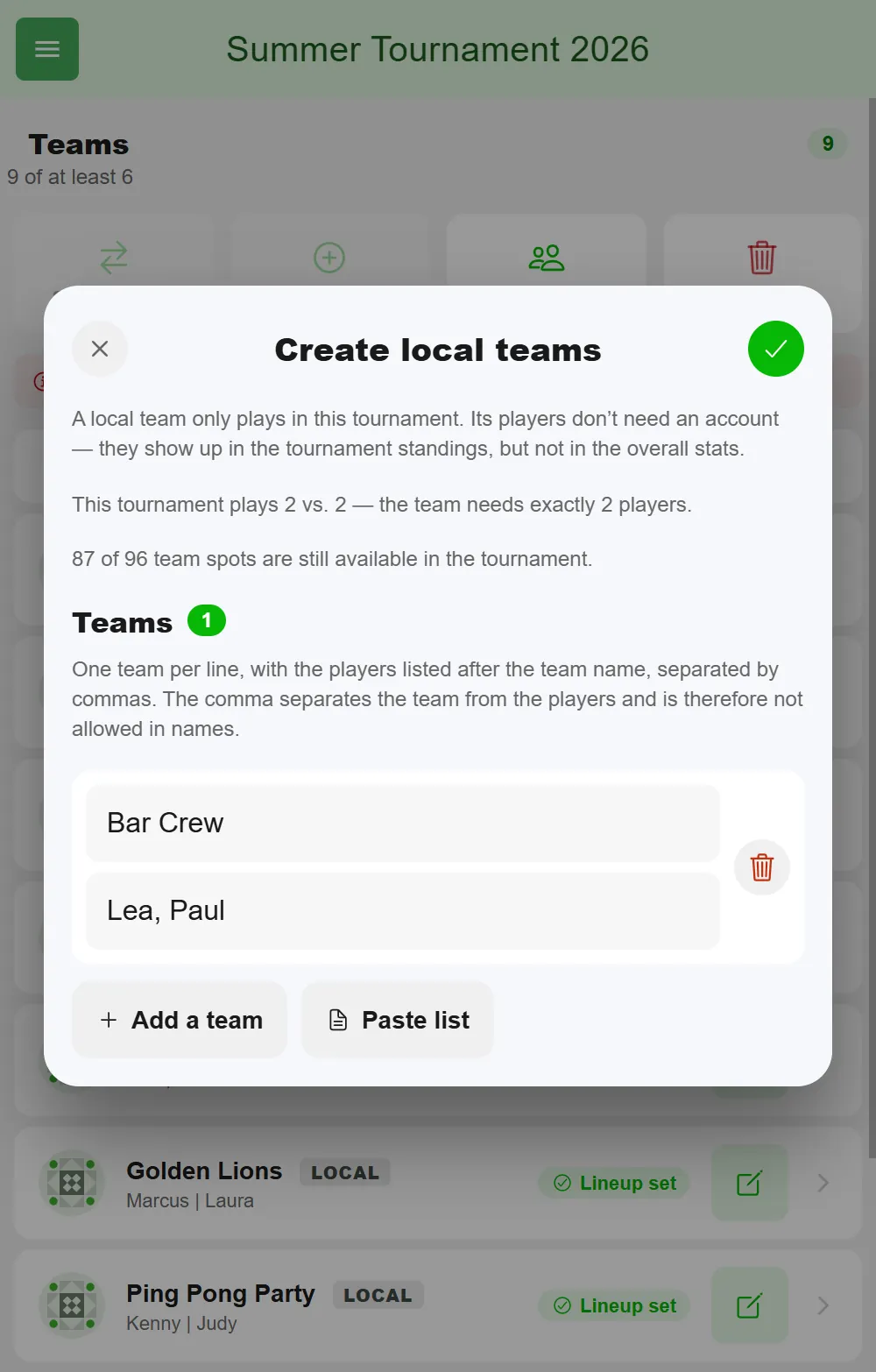
- The helper enters the teams as local teams. Quickest as a list while creating the tournament, one line per team: team name, then the players, separated by commas. Late sign-ups at the stand get added one by one in the tournament under Teams via “Local Team”. No account, no install, no email address. More on that in Beer pong tournament with players who have no account.
- Announce a sign-up deadline clearly and stick to it. “We start at three” means the list closes at 2:45 — otherwise you start at 3:40.
Entry fees are collected at the till as usual; BeerpongMe does not handle money between you and the players.
Add helpers as referees
This is the difference between a tournament that runs and one where a single person is glued to their phone all afternoon.
In the tournament settings you can add people as referees. They can start matches, enter results and finish them without playing themselves. At an event those are the two helpers standing at the table anyway, making sure the cups get refilled.
A useful side effect: no playing team has to enter its own result — one argument fewer. And if nobody at a table feels like tracking, the helpers simply enter the final score with “Enter result”; only the detailed stats are missing for that game.
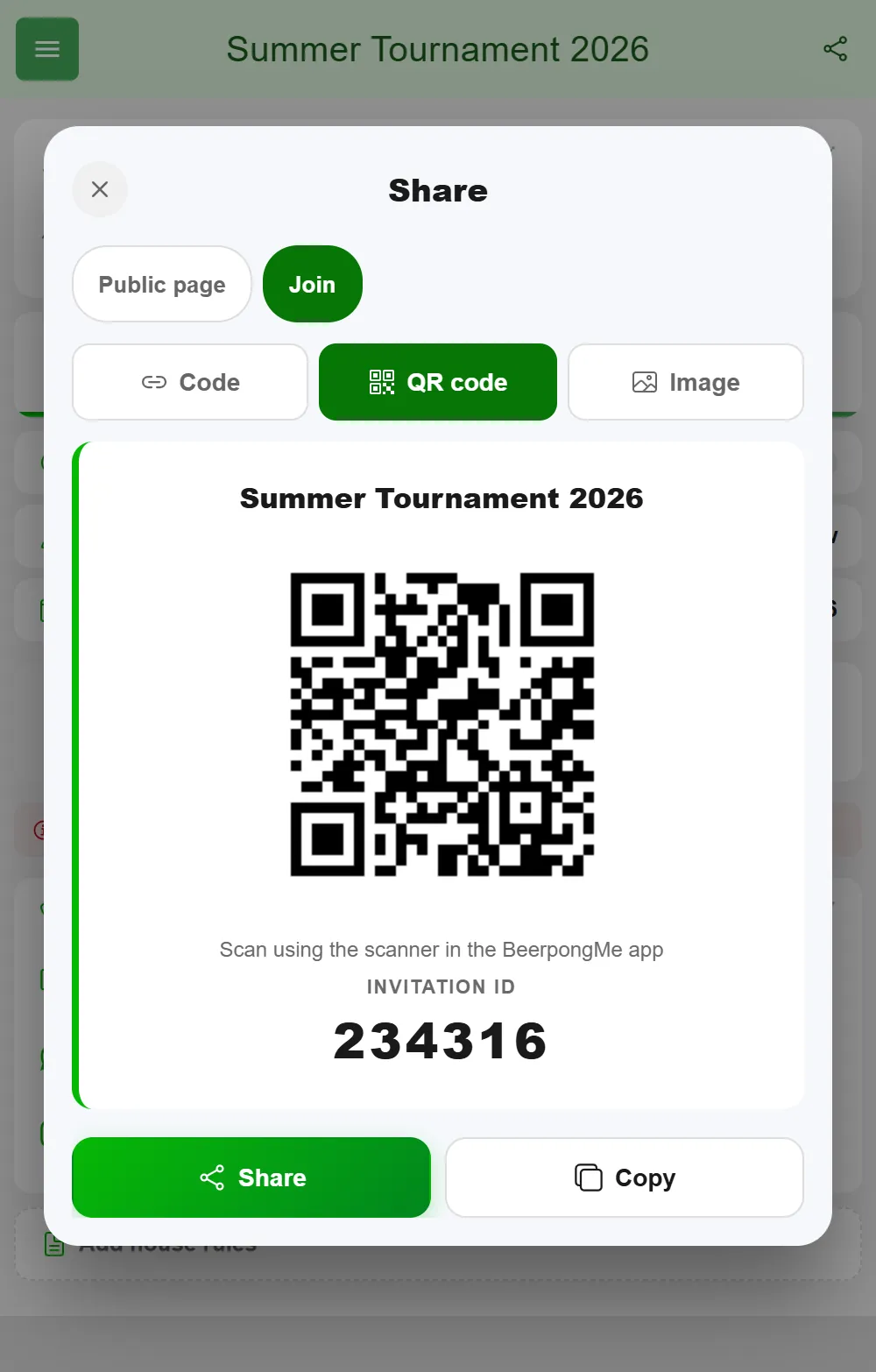
Anyone who already has the app can sign up on their own: “Share” → “Join” shows the tournament’s six-digit code and a QR code. The QR code only works with the scanner in the BeerpongMe app, not with the regular phone camera.
Age limits and the drinks question
This is where a club event differs from a student party, and the one point genuinely worth thinking about beforehand.
From the app’s side it is simple: BeerpongMe counts hits, not drinks. What is in the cups is your decision. A tournament with water runs exactly the same, standings and statistics included.
Three variants that have worked at events:
- Alcohol-free throughout, water in the cups, drinks available at the bar. That takes the whole discussion off the table and lets younger players join normally.
- Two separate slots — an open, alcohol-free tournament in the afternoon, the one with beer in the evening. In the app those are two tournaments, not one.
- Beer only for teams of legal age, water for the rest. It works, but it needs somebody paying attention.
The legal rules on serving alcohol to minors apply regardless of what the app does — that is your responsibility as the organizer, not a tournament app’s.
If you do this every year
The request comes up reliably: an overall ranking across the years, a club champion, a trophy with a table behind it.
BeerpongMe has no ranking across several tournaments. Each tournament stands on its own: no link between two tournaments, no series table, no points by finishing position. What does exist: every individual tournament stays available for good, with bracket, all matches and the standings. So you can always look up who won in 2025 — the yearly ranking itself you keep in your own list. What does help: “Run Tournament Again” on the summary sets up next year’s tournament in one go, with the same settings and the same local teams.
If people play against each other all year round, not just on the day of the event, a beer pong league suits better. It runs over weeks and has a rolling table — but no bracket, no group stage, and local players without an account do not exist there.
Making the standings visible
If you have a TV in the tent, put the bracket on it. It saves the “when are we up?” question and pulls in people who would otherwise have walked past. The schedule answers it even better: set up your tables beforehand in the “Tables” tab of the tournament settings, and it shows table and approximate start time for every game. If the event runs late, “Upcoming games +5 min” pushes all upcoming games back - details in Organize a beer pong tournament.
Relatives at home can follow along: new tournaments are public by default, so the tournament page is reachable without a login and refreshes itself while the tournament runs. So that people can ask questions in advance, use “Add contact information” on the tournament page to add, say, the club’s email address or Instagram account.
Who this article is not for
If it is a closed group rather than an open event, the matching plan is in Beer pong tournament bachelor party. For the company outing or the holiday party, Beer pong tournament corporate event fits better — it covers how to do it alcohol-free and in ninety minutes.
Frequently asked questions
How long does a beer pong tournament at a club event take?
Budget roughly 15 minutes per match at 10 cups. With two tables a 16-team tournament takes about three hours, with three tables a good two. If the tournament has to fit between two other acts, set the cup count to 6.
Can minors take part?
As far as the app is concerned, yes — it counts hits, not drinks. What goes in the cups is up to you. For a mixed public event an alcohol-free round or a separate water-only slot is the clean solution; the legal rules on serving alcohol to minors apply regardless.
Do players need a smartphone?
No. One helper creates the tournament and enters the teams as local teams — names only, no account. At an event that is the normal case, because nobody sets up an app at a sign-up stand.
Can we carry the tournament over year to year and keep an overall ranking?
BeerpongMe has no ranking across several tournaments — each tournament stands on its own. Every individual tournament does stay available for good, so you can always look up who won last year.
How much space does a beer pong table need?
A set-up table is about 2.44 metres long and 61 centimetres wide. So the teams can stand behind it and throw, budget roughly 3.5 by 1.5 metres of floor space per table.