Beer Pong Tournament Night Bar: Format, Entry Fee, Repeat
Jump to the FAQA beer pong tournament night is interesting for a bar for one simple reason: it pulls people in from a wider radius than a normal Wednesday, they arrive in pairs, they stay longer than one game — and whoever gets knocked out usually does not leave straight away. This article shows how a beer pong tournament night bar format actually runs: how many tables fit in your room, how sign-ups and entry fees work without a paper mess, and what makes a night worth repeating.
This is about the night as an event. If you would rather offer permanent tables where guests can start a match any time, Beer pong table with a QR code is the article you want. And what the screen in the room looks like is covered in TV display for your bar.
How many tables fit in your room
The number nobody measures beforehand and that decides the whole evening.
A set-up table is around 2.44 metres long and 61 centimetres wide. So both ends can throw and nobody is in the way, budget roughly 3.5 by 1.5 metres of floor space per table. Two tables side by side therefore need a good seven metres of wall.
| Tables | Teams | Cups | Realistic duration |
|---|---|---|---|
| 2 | 8 | 10 | approx. 1.5 h |
| 2 | 16 | 10 | approx. 3 h |
| 2 | 16 | 6 | approx. 2 h |
| 3 | 24 | 6 | approx. 2.5 h |
Budget roughly 15 minutes per match at 10 cups and about 10 at 6. The most important lever is not the team count but the cup count — if the night has to be done by ten, set it to 6 and nobody will notice.
Also plan for the buffer a bar has and a tournament hall does not: people fetch a drink in between, a team is outside, the kitchen calls.
What you need in terms of equipment
- Cups — 20 per table in play, plus at least double that as a refill. Cups are the item that runs out first
- Balls in triple the quantity. They roll under the bench and are gone
- A rinse cup of water at every table, plus paper towels
- A bucket and a cloth per table
- Two tables rather than one, even if you only expect eight teams. The second table halves the waiting time, and waiting is the point at which people go home
Sign-ups and entry fees
At a tournament night nobody installs an app in order to join in. The flow that works:
- Create the tournament the day before, with the name and date in the title — “Pong Night 21 Sept” is easier to find later than “Tournament 3”.
- Sign-ups at the till, together with the entry fee. Team name and two first names are enough.
- Enter the teams as local teams. While creating the tournament, paste them as a list into the “Teams” field, one line per team: team name, then the players, separated by commas. Anyone who turns up at the bar later gets added in the tournament under Teams via “Local Team”. No account, no install, no email address. Details in Beer pong tournament with players who have no account.
- Announce a sign-up deadline and stick to it. “We start at eight” means the list closes at 7:45.
Entry fees keep running through your own till — BeerpongMe does not handle money between you and the players. As a prize, a drinks voucher for the winning team usually works better than cash: it stays in the house and costs you the purchase price, not the sale price.
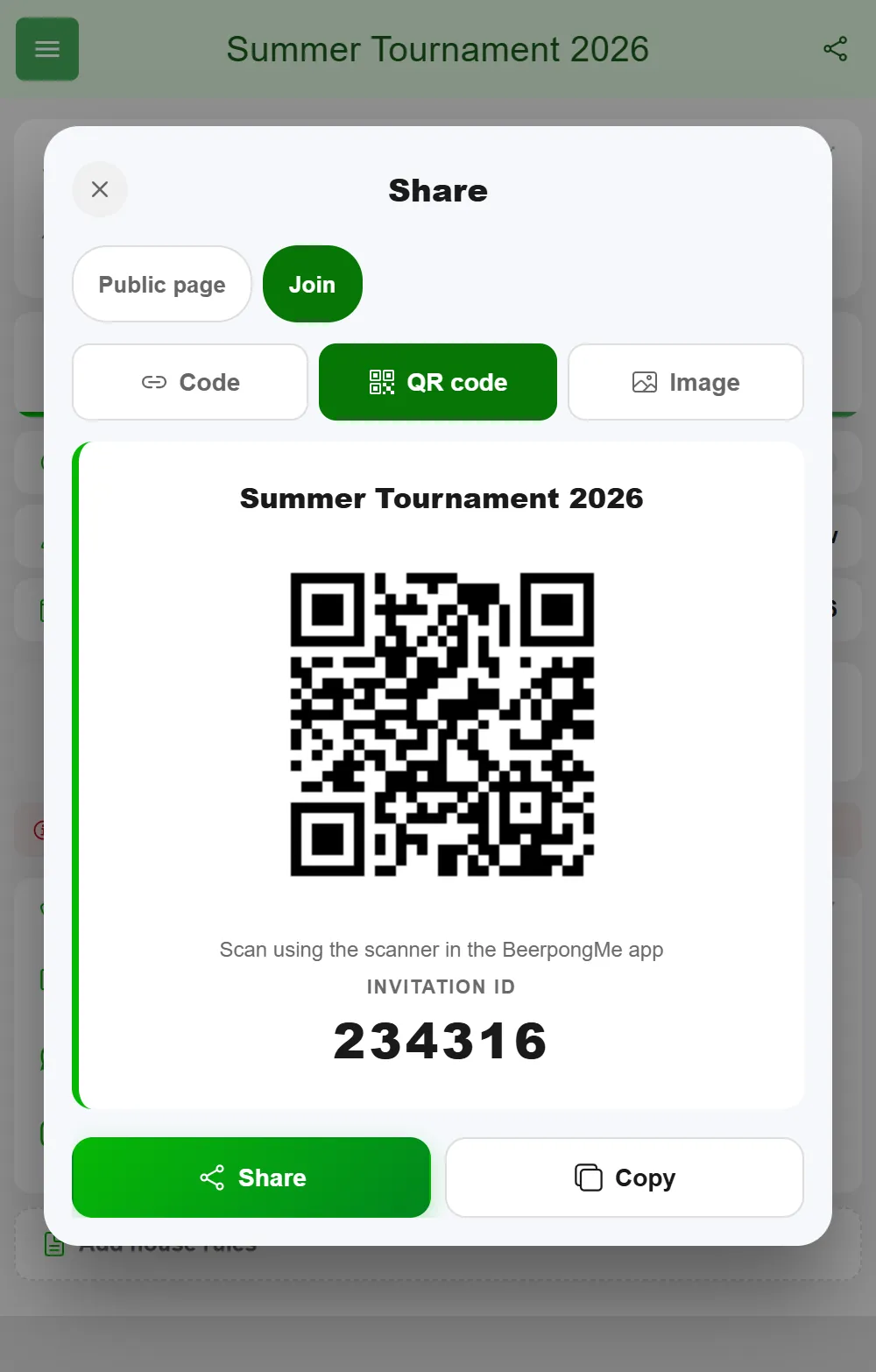
Anyone who has the app can join on their own: put the tournament’s six-digit code up large on the door, or post it on your social channel beforehand. If you print the QR code as well, write “scan in the BeerpongMe app” underneath - it only works with the scanner in the app, not with the regular phone camera. The easiest way is “Share” → “Join” → “Image”: BeerpongMe creates a ready-made invitation card there with the tournament name, QR code, code and exactly that hint.
Which format for walk-in crowds
On a bar night you have people who have played for years standing next to people doing it for the first time. Whoever is out after the first match and is supposed to watch for two hours leaves — and that is exactly the revenue the night was meant to bring in.
Double Elimination is therefore the sensible default: lose your first match and you land in the loser bracket and keep playing. Every team is at the table at least twice.
At 16 teams and with more time, a group stage followed by a knockout is better still, because every team gets three or four matches in the preliminary round. It needs at least six teams; with awkward numbers the groups end up different sizes, which is normal.
You do not need to even out awkward team counts: a pure knockout in BeerpongMe needs at least four teams and no power of two. Missing slots become byes that count as won straight away. If two more teams turn up at 7:50, you just take them.
Staff instead of self-service
The difference between a night that runs itself and one where you are glued to your phone: add two of your staff as referees in the tournament settings. They can start matches, enter results and finish them without playing themselves.
That way no playing team has to enter its own result, and you have one argument fewer at the table. Whoever is refilling cups anyway can set the result on the way past. If it needs to be quick, they tap “Enter result” on the game card and enter only the final score, without tracking every throw. That game then has no detailed stats, though.
House rules belong in there beforehand too — a free-text field of up to 2000 characters that every player sees inside the tournament. Put in what applies at your place: whether bounce shots count double, whether reaching over the table is allowed, what happens to knocked-over cups, and whether cups that are hit get drunk at all. That is the rules argument you would otherwise have three times a night.
What goes on the screen — and what does not
If you have a TV in the room, the bracket belongs on it. It answers “when are we up?” before anyone asks, and it pulls guests towards the table who would otherwise have walked past. With two or three tables, set them up beforehand in the “Tables” tab of the tournament settings: the schedule then shows for every game which table it’s on and roughly when - how that works is covered in Organize a beer pong tournament.
One limitation that matters for bars: the daily and all-time rankings on the TV display only count registered users and guests. Local teams — the free-text names walk-in crowds play under — do not appear there. If your night runs entirely on local teams, the top list on the screen stays empty.
Inside the tournament itself this is not an issue: local teams appear in the bracket and the standings as normal. It only affects the cross-table ranking on the TV display. If that ranking matters to you, it is worth nudging regulars towards creating an account — for instance through the table QR codes, which exist for exactly that.
The screen also has to be logged in; there is no anonymous wall display without an account. How to set it up is covered in TV display for your bar.
If the night is meant to come back
A single tournament night is a test. It gets interesting from the third one on — when people know that Wednesday means pong.
Two things carry that: a fixed rhythm (every other Wednesday beats “let’s do it again some time”), and the same rules every time. You can copy the house rules from the last tournament, then they are certainly consistent.
What BeerpongMe cannot do here: a ranking across several tournament nights. Each tournament stands on its own — no series table, no points by finishing position, no season ranking. What remains: every single night stays available for good, with bracket, all matches and the standings. So you keep a house championship over the season yourself, for instance in a list behind the bar that you update with the placings after each night. What does help: “Run Tournament Again” on the summary sets up the next night in one go, with the same settings and your regulars’ local teams.
The result is readable outside the bar too: new tournaments are public by default, so the tournament page is reachable without a login and refreshes itself during the night — nobody has to reload the TV behind the bar. For your social post the next day, “Share results” on the summary creates a ready-made graphic with the podium and the link to the tournament page. Under “Add contact information” you can also add the bar’s Instagram or WhatsApp, so teams can get in touch about the next night directly.
Who this article is not for
If it is not about one night but about permanently playable tables where guests can start a match any time, that is covered in Beer pong table with a QR code. If the event is a private party — a corporate function in the back room, a bachelor party — then Beer pong tournament corporate event and Beer pong tournament bachelor party fit better.
Frequently asked questions
How many tables fit in a normal bar?
A set-up table is around 2.44 metres long and 61 centimetres wide, and with throwers at both ends you need roughly 3.5 by 1.5 metres. Two tables work in most bars; three only if you give up seating.
How long does a tournament night with 16 teams take?
On two tables at 10 cups roughly three hours. If you want to be done by ten, set the cup count to 6 or add a third table — then it is about an hour and a half.
Can I collect the entry fee through the app?
No. BeerpongMe does not handle money between you and the players. You take entry fees at the till; the app handles the bracket, the schedule and the results.
Do walk-in teams show up in the daily ranking on the screen?
No. The daily and all-time rankings on the TV display only count registered users and guests. A bar that plays purely with local teams sees an empty top list there. Inside the tournament itself those teams appear in the standings as normal.
Can I keep an overall ranking across several tournament nights?
Not in BeerpongMe. Each tournament stands on its own, there is no series table across tournaments. Every single night does stay available for good, so you can always look up winners and results.