Beer Pong Tournament Rules: Template for Rulebook and Schedule
Jump to the FAQThe tournament is announced, 16 teams have signed up - and then it’s 8:40 pm, one team still isn’t there, two groups finish level on wins and there’s an argument about a bounce shot at the final table. Moments like these decide whether a night is remembered as a good tournament. Good beer pong tournament rules settle them before they happen.
How to play beer pong at the table is already covered in Beer Pong Rules. This article is about what a tournament needs on top of that: a rulebook for organisation, scoring and disputes, and a schedule that fits your time and your tables. You can take both as a template and adapt them.
Beer pong tournament rules: seven things to decide in advance
The rules at the table are only part of it. These questions come up at every tournament night, and each one should have a fixed answer:
- Team size and substitutes. Two against two is the standard. Decide whether a team may bring a substitute and whether players can be swapped during the tournament - or only before the first match.
- Rules at the table. Number of cups (10, 6 or 3), rerack, redemption and overtime. If you have to get 16 teams through in one evening, it’s common to play the early rounds with 6 cups and only the final rounds with 10.
- Who starts. Coin toss, rock-paper-scissors or “eye to eye”. In the knockout stage, the team with the better group record often gets to choose.
- No-shows. A fixed grace period after the call, typically 5 to 10 minutes. After that the match is lost.
- Ties in the standings. A fixed order of criteria - more on that below.
- Time limit. Whether there is one and what happens when it runs out.
- Disputes. Who decides, and that the decision stands.
Then there are the house rules: does a bounce count double? Is blowing allowed? What’s usual at tournaments is in the “Standard or house rule?” table in Beer Pong Rules. Rule of thumb: the fewer of the teams know each other, the closer you should stay to the standard.
Ties in the group stage and Swiss system
Sooner or later, every preliminary round ends with two teams on the same number of wins. A proven order for separating them:
- Wins
- Head-to-head - who won the match between the two?
- Cup difference - cups hit minus cups conceded across all matches
- Total cups hit
- Shoot-out - one throw each, alternating, until one team hits and the other misses
You don’t need to award points per win. Since beer pong has no draws, the number of wins tells you the same thing.
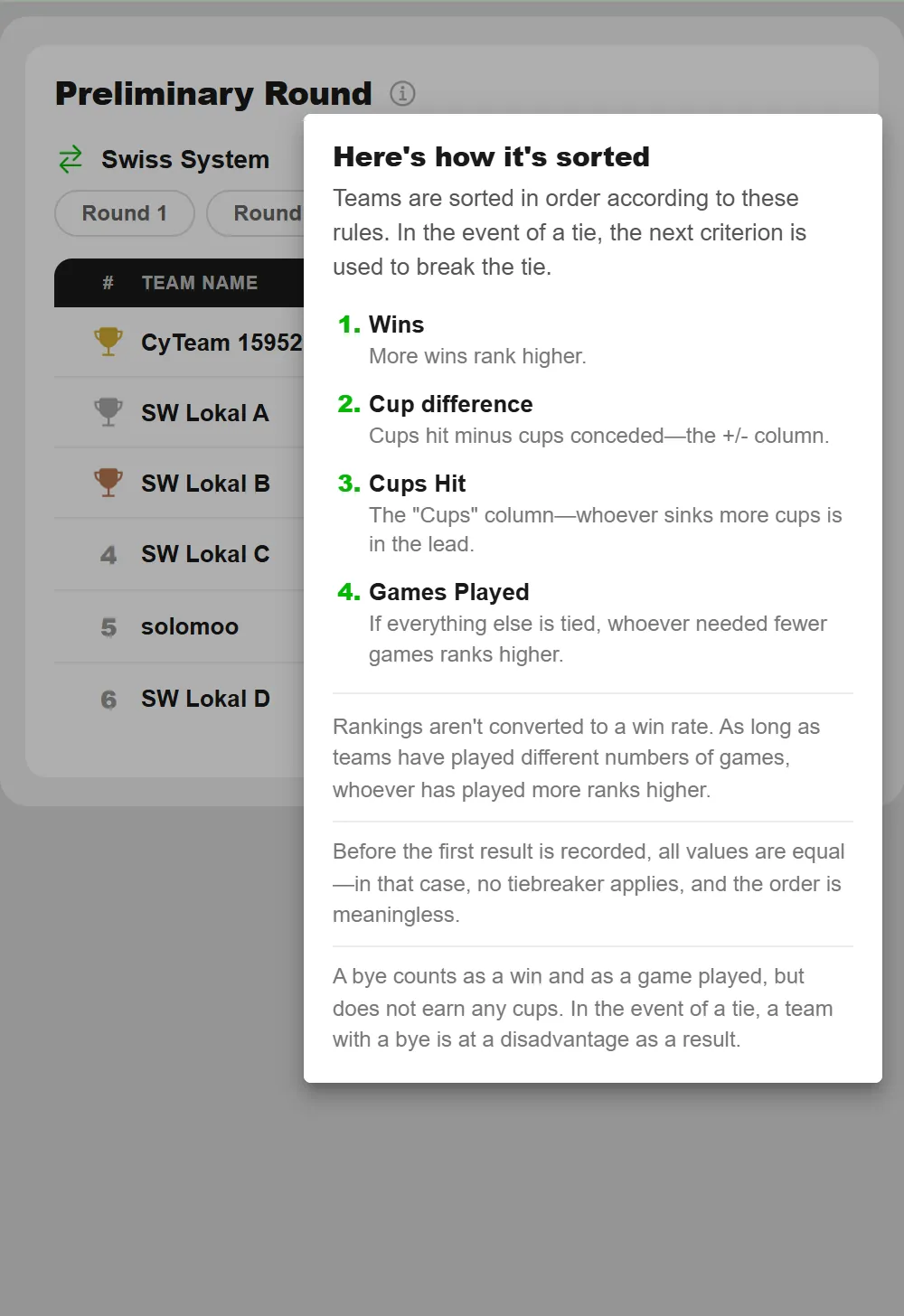
If you run the tournament in BeerpongMe, the standings show wins, losses, cup difference and cups hit for every team automatically. The group stage, round robin and Swiss system - a format where each round pairs teams with a similar record - are all sorted in the same order:
- Wins
- Cup difference
- Cups hit
- Games played - if everything else is level, the team that needed fewer games for it goes first
The app does not factor in head-to-head or a shoot-out. Wins aren’t converted into a win rate either: as long as teams have played different numbers of games, the one that has played more stays higher. In the Swiss system a bye counts as a win but brings no cups - so in a tie, a team that had a bye is at a disadvantage. The app shows these rules itself, behind the info icon next to “Preliminary Round”.
If you’d rather break ties by head-to-head, that’s a house rule you have to enforce yourself. The simplest approach is to announce beforehand that the app’s order applies and put that in the house rules - then there’s nothing to negotiate at the table.
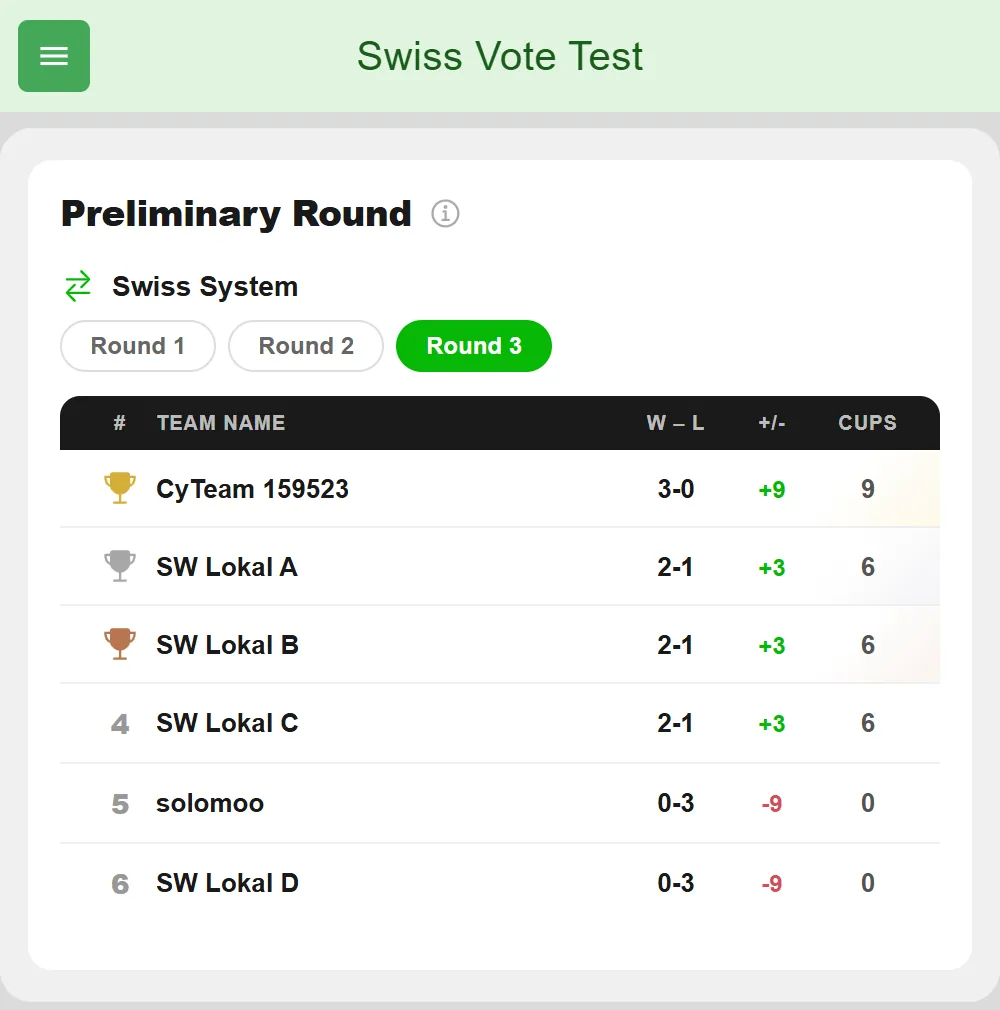
That’s exactly the situation in the standings above: three teams are dead level on 2-1, +3 and 6 cups hit each, after the same number of games. None of the four criteria separates them any more - so the order of those three is pure chance. If a semi-final spot depends on it, you need a rule of your own, such as a shoot-out, and you should have agreed on it before the first throw.
No-shows, time limits and disputes
No-shows. Call every match out loud or put it on a screen, and start the grace period from the call, not from the scheduled time. A team that’s late because the previous table ran over isn’t to blame. If a team doesn’t turn up at all, it loses the match. If a team drops out in the middle of the group stage, the cleanest solution is to count all of its matches as lost - that keeps the standings fair for everyone else.
Time limit. A beer pong match with 10 cups takes about 15 minutes on average, but some drag on for 30. On a tight schedule a limit helps, say 20 minutes. When time is up, each team gets one more full round, then the team that has hit more cups wins. If it’s still level, go straight to overtime with 3 cups. BeerpongMe doesn’t stop a match automatically - the organisers enforce the time limit. If you’ve set up tables in the app, the schedule shows an approximate start time for every game; if the night falls behind, “Upcoming games +5 min” pushes all games that haven’t started yet back. How to set that up is covered in Organize a beer pong tournament.
Disputes. Does the throw count, was the elbow over the edge? Decide who rules on it: the organisers or neutral referees. From about 16 teams upwards it’s worth having at least one person who isn’t playing. In BeerpongMe you can hand out the Referee role for this: referees start matches, enter hits and end matches without being on a team themselves. Important: once a match has been ended, the result in the app is final. So settle any disputed point before anyone taps “End Game”.
Tournament schedule template: matches and time needed
How long your tournament takes comes down to three numbers: teams, tables and format. The number of matches is fixed:
| Format | 8 teams | 16 teams | 32 teams | Formula |
|---|---|---|---|---|
| Single elimination | 7 | 15 | 31 | teams − 1 |
| Double elimination | 14–15 | 30–31 | 62–63 | 2 × teams − 2, +1 with reset |
| Swiss system | 12 (3 rounds) | 32 (4 rounds) | 80 (5 rounds) | rounds × teams ÷ 2 |
| Round robin | 28 | 120 | 496 | teams × (teams − 1) ÷ 2 |
Double elimination means a team that loses once drops into a second half of the bracket, the losers’ bracket, and is only out after a second loss. The reset is a possible extra match in the final if the team from the losers’ bracket wins the first final.
Estimate the time like this: matches ÷ tables × 15 minutes, then add a third as buffer. In single elimination the formula is only a rough guide, because the later rounds have fewer matches than tables. There you get a more accurate number by going round by round. Two worked examples with 16 teams and 4 tables:
Single elimination, 16 teams
| Round | Matches | Time slots | Duration |
|---|---|---|---|
| Round of 16 | 8 | 2 | 30 min |
| Quarter-finals | 4 | 1 | 15 min |
| Semi-finals | 2 | 1 | 15 min |
| Final | 1 | 1 | 15 min |
| Total | 15 | 5 | 75 min + buffer ≈ 1:45 h |
Swiss system followed by knockout, 16 teams
| Phase | Matches | Time slots | Duration |
|---|---|---|---|
| Swiss, 4 rounds | 32 | 8 | 120 min |
| Quarter-finals (top 8) | 4 | 1 | 15 min |
| Semi-finals | 2 | 1 | 15 min |
| Final | 1 | 1 | 15 min |
| Total | 39 | 11 | 165 min + buffer ≈ 3:40 h |
On top of that, plan 30 minutes before the first match for check-in, setup and announcing the rules. As a guide for tables: one table per 4 to 6 teams.
Which format suits which number of teams is explained in the format table in Organize a Beer Pong Tournament. The short version: single elimination is quick, but it’s over after one match for half the teams. A Swiss system or a group stage followed by knockout gives every team several matches without the night getting as long as a round robin.
The rulebook to copy
This template covers the points above and, at around 1,000 characters, fits into the House Rules field of a BeerpongMe tournament, which holds up to 2,000. Replace the values in square brackets with your own:
TOURNAMENT RULES [tournament name]

Teams: 2 players per team, [1] substitute allowed. Players can only be swapped between matches.

Rules: [10] cups in a pyramid. Rerack at [6 and 3] cups. When the last cup falls, the team that got hit gets a redemption. Tie = overtime with 3 cups.

Who starts: coin toss. In the knockout stage, the team with the better group record chooses.

Not allowed: swatting balls out of the air, blowing, fingering. A bounce counts as one cup, not two.

Call: a team that isn't at the table [10] minutes after being called loses the match.

Time limit: [20] minutes. After that, one full round for each team, then whoever has hit more cups wins. If tied, overtime.

Ties in the standings: the app's order applies - 1. wins, 2. cup difference, 3. total cups hit, 4. fewer games played.

Disputes: the organisers decide, and the decision stands. Objections only before the match is ended.

Conduct: anyone who insults other teams or knocks over cups on purpose can be disqualified.
Step by step: getting your rulebook into the tournament
- Create the tournament as described in Organize a Beer Pong Tournament.
- In the first step of creating the tournament, “How do you want to play?”, set the things the app keeps track of: lineup size (1 vs 1 up to 4 vs 4) and the number of cups - separately for the preliminary round and the knockout round if you have a preliminary round - and, under “More options”, Rerack and “Last cup to the front”.
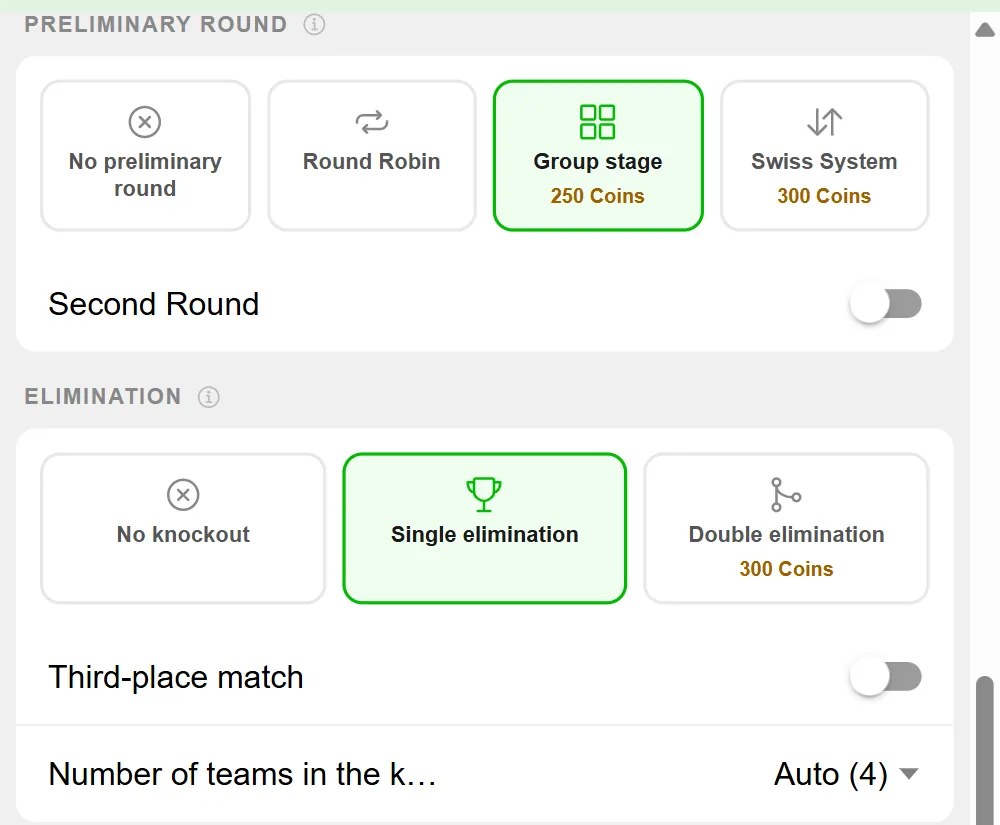
- Choose the format. For the Swiss System, BeerpongMe suggests the right number of rounds for your team count. With a preliminary round, “Number of teams in the knockout stage” decides how many teams go through (4, 8, 16, 32 or 64) - or you leave it on “Auto”. Then half of the teams advance, rounded down to one of those numbers and at least 4; the app shows the number right next to it, for example “Auto (8)” with 16 teams. If you like, switch on the Third-place match or the Grand Final Reset. With a preliminary round you can also drop the knockout entirely; then the table alone decides.
- Copy the template above, adjust the values and paste it in via “Add house rules” on the tournament page.
- In the tournament settings, add the people who should settle disputes under “Referees”. Referees are free.
- Check everything before you start: once the tournament has started, the house rules and lineup size are locked and can’t be changed.
Participants then see the house rules right in the tournament. That still doesn’t replace a quick announcement before the first match - just mention the three points that otherwise get argued about: bounce shots, the grace period and who decides.
What this article isn’t for
This covers the rules around a tournament, not how to use the app and not the game itself. Depending on what you’re looking for, another article is a better fit:
- The basic rules at the table - setup, throwing order, redemption, house rules: Beer Pong Rules
- Creating a tournament step by step, inviting teams and running it live: Organize a Beer Pong Tournament
- Not a one-off event but a season with standings: Create a Beer Pong League
- Some of the participants don’t have an account: Play Beer Pong Without an Account
Frequently asked questions
What should the rules for a beer pong tournament cover?
Besides the rules at the table, mostly the organisational side: team size and substitutes, number of cups and reracks, who starts, what happens when a team doesn't show up, how ties in the standings are broken, whether there is a time limit and who has the final say in a dispute.
How many matches does a beer pong tournament with 16 teams have?
15 matches in single elimination, 30 or 31 in double elimination (with a grand final reset), 32 in a Swiss system with 4 rounds and 120 in a round robin. With 4 tables and 15 minutes per match, a single elimination tournament with 16 teams takes about 75 minutes of pure playing time.
What happens if a team doesn't show up to a beer pong tournament?
The organisers decide that in advance. A grace period of 5 to 10 minutes after the call is common; after that the match counts as lost. What matters is that everyone knows the deadline before the tournament, not only once there is an argument.
How are ties in a group broken?
This order works well: number of wins, then head-to-head, then cup difference, then total cups hit. If it is still tied, a sudden-death shoot-out decides. BeerpongMe sorts its own standings without head-to-head: by wins, cup difference, total cups hit and finally fewer games played.
Can a beer pong tournament match end in a draw?
No. If the team on redemption hits all remaining cups, the match goes to overtime with 3 cups per side - until one side wins. That is why a tournament match always has a winner.