Beer Pong Rules: The Official Rulebook and Common House Rules
Jump to the FAQTen cups are standing, the first ball flies - and by the time the last cup goes down, the argument starts. Is there a redemption now? Does the bounce count double? Can you rerack, and how often? The problem is not a lack of beer pong rules, it is the sheer number of them: one international tournament rulebook, several national league rulebooks, and a different variant in every shared flat.
This article separates the two properly. First the standard that applies on more or less any tournament table, then the widespread house rules - and where the two contradict each other. By the end you will know what to agree on before the first throw.
The setup: table, cups, balls
Beer pong is played two against two, each team on one side of the table. One on one works the same way, but it is the exception.
- Table - roughly 244 x 61 cm at about 70 cm high. Those are the 8 feet from the US original. German leagues phrase it as a minimum: at least 240 cm long, at least 70 cm high. Two folding tables pushed together will do at home.
- Cups - 10 per side. Classically the red 16 oz cup, so around 473 ml, about 12 cm tall with a 9.5 cm rim.
- Formation - a 4-3-2-1 pyramid, tip pointing towards the middle of the table. The back row sits one or two centimetres from the edge.
- Filling - at a party the cups are filled halfway, roughly one litre of beer per team in total. Leagues put about 200 ml of water in each cup and drink separately.
- Balls - two table tennis balls, 40 mm, 2.7 g. Each side of the table also gets a cup of water for rinsing the ball.
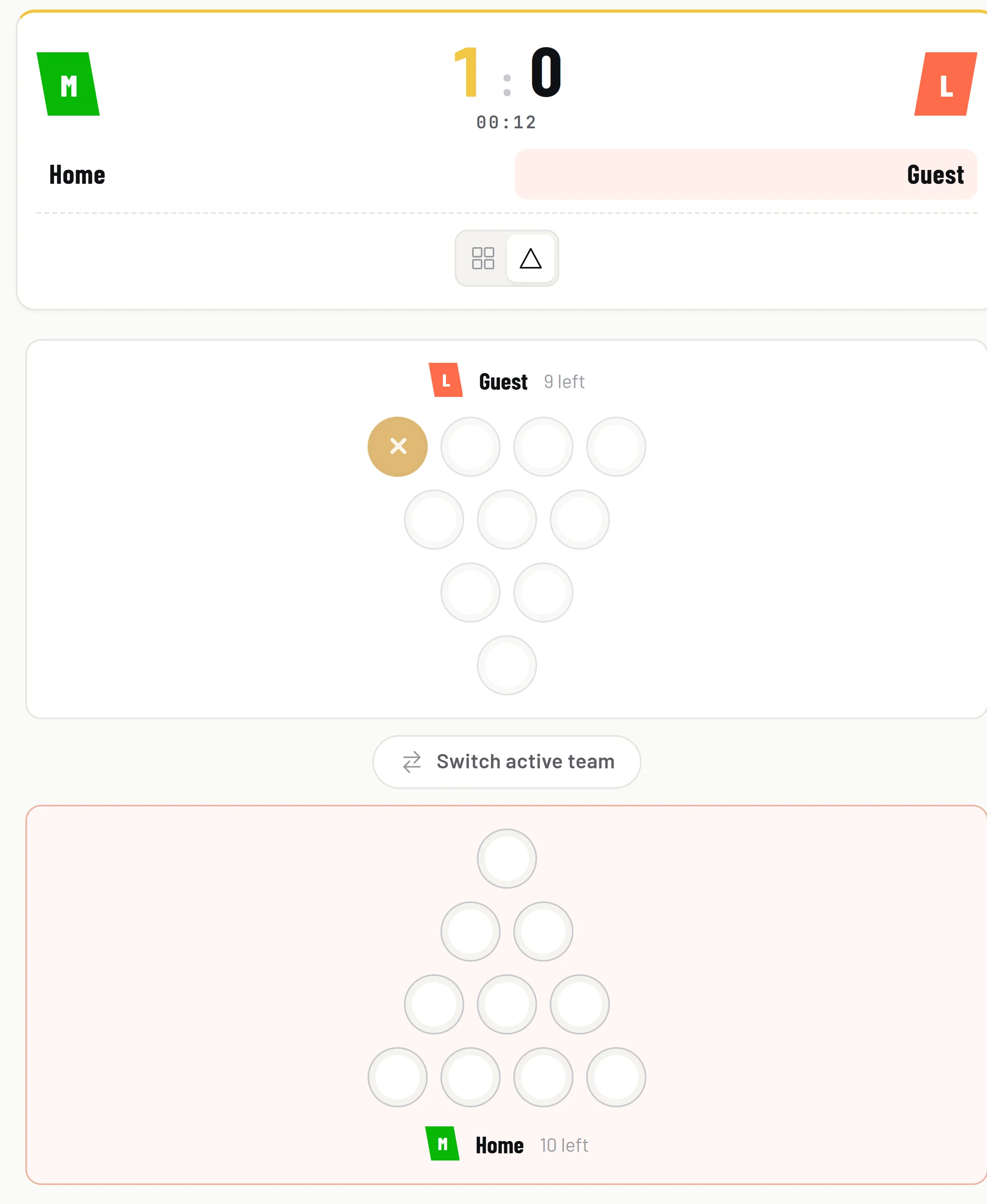
Besides the classic 10-cup pyramid, two short formats are common: 6 cups (3-2-1) and 3 cups (2-1). Both are quick, which makes them popular on tournament days packed with matches. Nothing about the rules changes - overtime just arrives sooner.
Beer pong rules step by step
- Set up. Both sides build their pyramid, tip towards the middle, and fill the cups to the same level.
- Decide who starts. At a party this is settled by “eyes”: one player per team throws at the same time while looking the opponent in the eye - whoever hits goes first. Tournaments are drier about it and use a coin toss or rock-paper-scissors; in the knockout rounds the higher seed often picks between starting and choosing a side of the table.
- Shorten the first round. The starting team throws only one ball in the opening round. Otherwise it would end up one ball ahead - and that single ball is what makes the redemption rule further down add up.
- Throw. After that each team gets two throws per round, one per player. Both feet stay behind the edge of the table. Whether the elbow has to stay behind it as well is a matter of interpretation: the party version knows the elbow rule, several tournament rulebooks deliberately drop it.
- Score the hit. A cup that gets hit is drunk and taken off the table. The gap stays - cups only move closer together on a rerack.
- Balls back. If both players hit in the same round, the balls come back and the team throws again straight away. This can repeat any number of times.
- Rerack. At set points the remaining cups may be rearranged - more on that below.
- The last cup. Once it falls, the team it was taken from gets its redemption - and what happens there decides the game.
You may only touch the ball after it has hit the table or a cup. Swatting a ball out of the air is banned in every rulebook meant seriously.
Redemption and overtime - the biggest source of arguments
This is where most games turn into a debate, even though the logic is simple: no side should lose without having thrown the same number of balls.
That is what the one-ball opener from step 3 is for. It shifts the counts so that the team whose last cup has just been hit is always exactly one ball short - regardless of who opened the game. Which is why the official rulebooks grant it without exception: once the last cup falls, the team it was taken from gets a redemption - also called a rebuttal depending on the rulebook.
That team then keeps throwing until it misses for the first time. In doubles the partners alternate; one player may not take every redemption throw.
- If they miss, the game is over.
- If they clear every remaining cup, the score is level - and it goes to overtime.
Overtime is played with 3 cups per side, set up as a small pyramid. No reracking there. Who throws first is the one point where the rulebooks differ - usually it is the team that had already won. And because the redemption rule still applies in overtime, the whole thing can repeat until one side closes it out cleanly. A final score above the actual cup count, say 13:10, is therefore not a typo but a game that went to extra time.
Reracks: when the cups get rearranged
Once only scattered cups are left, you are throwing at single targets. That is why they may be pushed back together at certain points - a rerack. It always happens at the start of your own throwing round, never mid-throw.
How often is handled differently from rulebook to rulebook:
- Fixed thresholds: the cups are rearranged automatically as soon as 6, 3 or 1 are left. Common in the German leagues because it leaves nothing to negotiate.
- Free choice with an allowance: each team may rerack twice per game and picks the moment and the shape itself. This is the usual international tournament variant.
- Fixed shapes: pyramid, diamond and straight line are allowed - no invented arrangements, no cups strung along the edge of the table.
- Last cup to the front: if only one is left, it may be pulled to the tip position. This exception applies almost everywhere, including in places where reracking is otherwise finished.
In a 3-cup game there is no reracking - it goes straight to overtime.
Standard or house rule?
The short overview for the moment things get loud at the table:
| Rule | In a tournament | At a party |
|---|---|---|
| 10 cups, 4-3-2-1 pyramid | standard | standard |
| Two throws per round, balls back | standard | standard |
| Redemption and 3-cup overtime | standard | often forgotten |
| Reracks at thresholds or on an allowance | standard | negotiated freely |
| Elbow behind the edge of the table | depends on the rulebook | usually yes |
| Bounce shot counts double | no | usually yes |
| Blowing and fingering | banned | widespread |
| Death cup | no | widespread |
| “On fire” after a streak | no | widespread |
| Trick shot for an extra cup | sometimes, with a penalty | widespread |
The most popular house rules
None of these appear in an official rulebook. They make the game faster and louder - which is exactly why they need to be agreed on in advance.
- Bounce shot. The ball bounces on the table before landing in a cup: counts two cups, the one you hit plus one of your choice. The catch is that a bouncing ball may be swatted away. In a tournament a bounce is an ordinary throw with no bonus.
- Blowing and fingering. While the ball is still spinning in a cup without having touched the beer, it may be removed - traditionally women blow, men use a finger. Any form of ball defence is banned in every tournament.
- Death cup. A cup that was hit but neither emptied nor cleared away ends the game instantly if it gets hit again. A reliable way to speed up the drinking.
- On fire. Hit two or three times in a row and you are “on fire”, throwing on until you miss.
- Trick shot. Behind the back, over the shoulder or with your eyes closed. Some rulebooks even know it officially - there it costs the opponent an extra cup.
- Same cup. If both balls of a round land in the same cup, that cup plus two more go down. Careful: several league rulebooks say the exact opposite, namely that a second throw into an already-hit cup is void.
- Island. A cup standing on its own, touching no other, is called before the throw. Hit it and you get an extra cup; miss it into the cluster and the hit does not count.
Whether you play beer pong with or without these extras is a matter of taste. What matters is that the agreement stands before the opening throw - otherwise the loudest argument wins afterwards.
Storing your rules in the app
This is exactly where BeerpongMe comes in: instead of renegotiating every round, you set the rules once and the app walks you through everything else - including the situations that usually get missed.
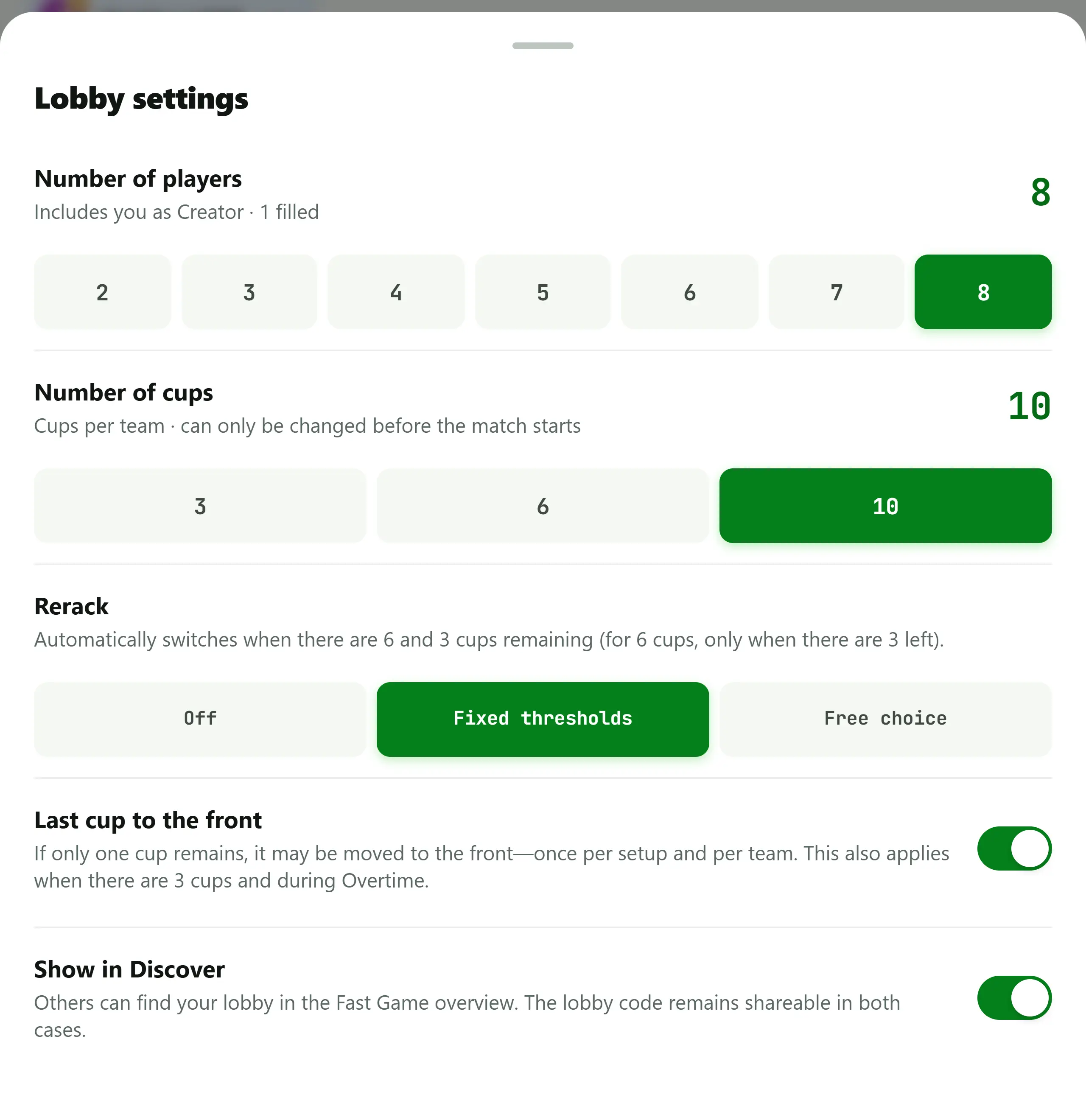
- Number of cups - 3, 6 or 10 cups per team.
- Rerack - Off means never. Fixed thresholds rearranges automatically once 6 or 3 cups are left. Free choice leaves the moment and the formation to the players, limited by the number of reracks per team.
- Last cup to the front - a separate switch, once per setup and per team, and allowed in overtime too.
- Redemption and overtime run on their own. Once the last cup of a side falls, the app flags the redemption for exactly that side, and for overtime it sets up three cups at the tip on both sides.
- House rules as free text - leagues and tournaments have their own field for it. That is where everything the app cannot count goes: “bounce counts double”, “no reaching in”, “death cup applies”. Everyone involved sees it before the match.
For how a match works in practice, see Start a Fast Game - the spontaneous version with no sign-up and no setup.
Where to go from here
This article explains the rules, not the organisation around them. Once you are past the single round, these are your next steps:
- Playing regularly with the same crowd and want a table of standings across a season? That is a beer pong league.
- Planning a one-off event with a lot of teams and a bracket? See organising a beer pong tournament.
- Half your group refuses to sign up? Playing beer pong without an account covers guests and local players.
- Curious what all those throws add up to? Have a look at tracking beer pong stats.
Frequently asked questions
How many cups do you need for beer pong?
Ten cups per team is the standard, set up as a 4-3-2-1 pyramid with the tip pointing towards the middle of the table. Short formats use 6 or 3 cups per side, which is common on tournament days with a lot of matches to get through.
What are the dimensions of an official beer pong table?
Roughly 244 x 61 cm at about 70 cm high - that is the US measurement of 8 feet in length. German leagues state it as a minimum: at least 240 cm long and at least 70 cm high. For home use, any sturdy table in that range works.
What is redemption, or rebuttal?
Once the last cup of a team has been hit, that team gets a redemption - no matter who started. It keeps throwing until it misses for the first time, alternating between partners in doubles. If it clears every remaining cup, the score is level and the game goes to overtime instead of being lost.
How does overtime work in beer pong?
Overtime is played with 3 cups per side, set up as a small pyramid. No reracks are allowed there. Whoever levels the score again forces another overtime - you keep playing until one side closes it out.
Does a bounce shot count double?
At a party, usually yes: the cup you hit plus a second one of your choice. The catch is that a bouncing ball may be swatted away by the other team. In the tournament rulebooks a bounce shot is an ordinary throw with no bonus - it counts exactly one cup.