Beer Pong Tournament With an Odd Number of Teams: Byes and No-Shows
Jump to the FAQYou planned for 16 teams, 13 are on the list, and just before kickoff another team drops out. At a beer pong tournament, an awkward or odd number of teams is the norm, not the exception.
The good news: you don’t have to cut anyone or find a replacement. BeerpongMe distributes the teams to fit and hands out a bye where one is needed. A bye means a team doesn’t have to play that round because, mathematically, there’s no opponent left. This article shows what that means for each format and what to do when a team doesn’t turn up at all. It works the same for a tournament among friends as for a big event.
Which team counts work with which format?
You always need at least 4 teams, and 6 for a group stage. You can register up to 96 teams, and up to 64 make it into the knockout bracket.
| Format | Odd number of teams | What happens |
|---|---|---|
| Knockout only | Works | Empty spots in the bracket become byes |
| Groups + Knockout | Works | Groups may differ by one team |
| Round Robin | Works | Every team plays all the others, nothing needs balancing |
| Swiss System | Works | One team gets a bye each round |
| Last One Standing | Works | One team sits out each round and doesn’t lose a life |
Organize a beer pong tournament explains how to choose a format.
Byes in the knockout bracket
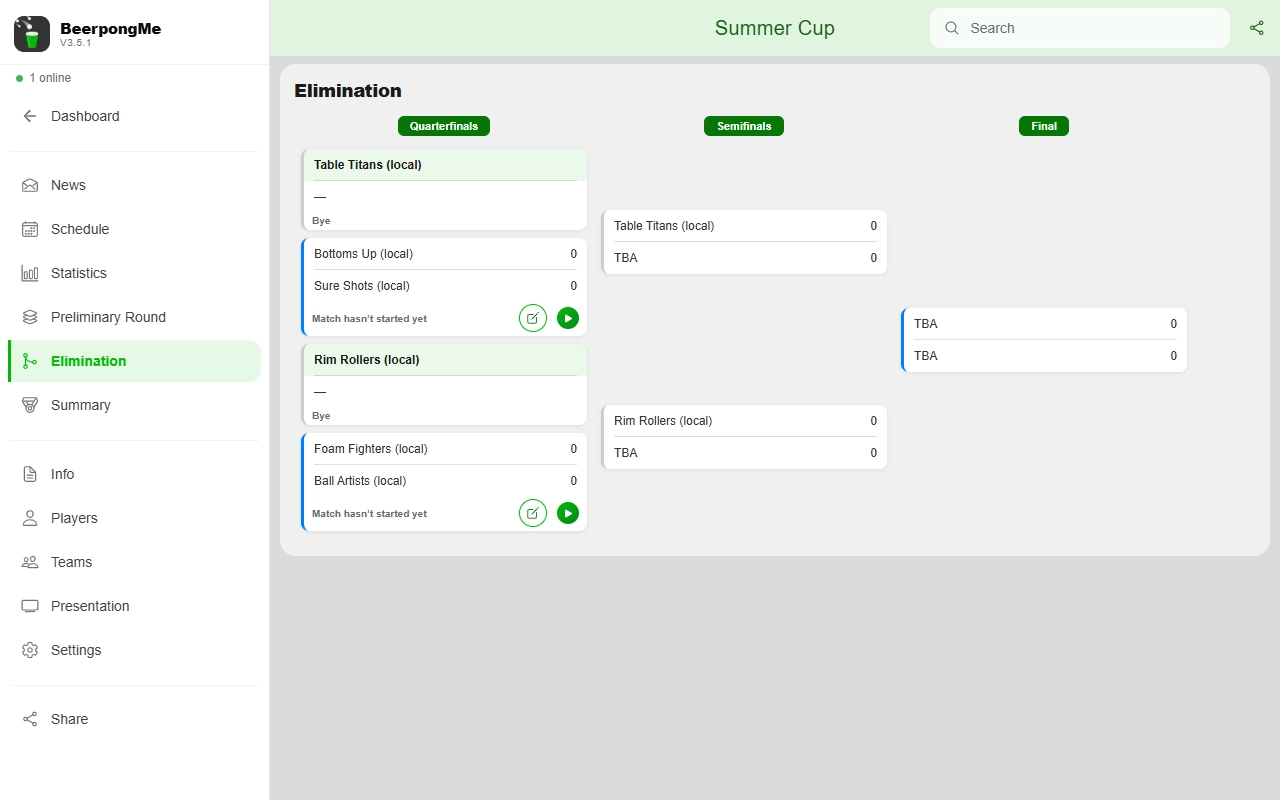
Mathematically, a knockout bracket needs 4, 8, 16, 32 or 64 spots. With any other team count, BeerpongMe fills the empty spots with byes. Those teams move on to the next round without playing.
Without a preliminary round, all registered teams always play, in both single and double elimination. You don’t have to set anything.
After a preliminary round in single elimination, you decide how many teams advance under “Teams advancing”: any number from 2 to 64, up to the number of registered teams. So “3 groups, top 2 advance” or a “Top 12” both work. The byes go to the highest-placed teams from the preliminary round.
Two examples from practice:
- 6 teams in the knockout: The bracket has 8 spots. The teams in 1st and 2nd place get a bye and go straight to the semifinals.
- 5 teams in the knockout: The bracket also has 8 spots, and here there are 3 byes.
On “Auto”, half of the teams advance, rounded down to 4, 8, 16, 32 or 64 and at least 4.
There are two exceptions to know about:
- Double elimination after a preliminary round still only works with 4, 8, 16, 32 or 64 teams. If you switch to double elimination, the selection jumps to the next size that fits.
- The third-place match only exists with 4 or more teams in the knockout.
Group stage with uneven groups
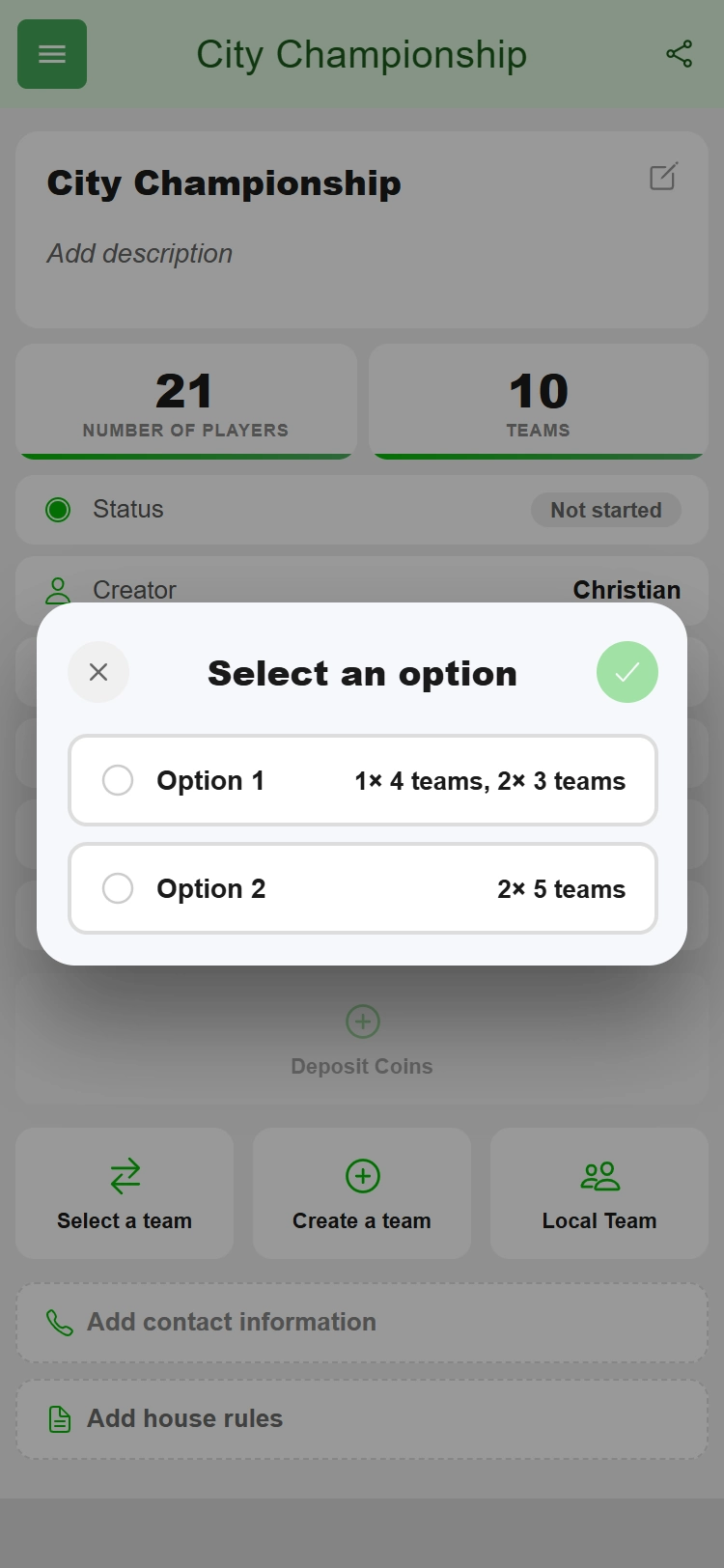
Groups may differ by one team, and the smallest group has 3 teams. Larger groups come first. You decide this when you start the tournament: if there are several sensible splits, the app asks.
| Teams | Possible splits |
|---|---|
| 6, 7 or 8 | The app doesn’t ask, there are 2 groups (3/3, 4/3 or 4/4) |
| 9 | 3/3/3 or 5/4 |
| 10 | 4/3/3 or 5/5 |
| 11 | 4/4/3 or 6/5 |
A group of 4 has 6 games, and a group of 3 has 3. So a team in the larger group plays more games. Within a group that’s fair, because everyone plays the same number of games. To keep comparisons fair across groups, those comparisons use win rate and cup difference per game, for example when deciding which third-placed teams advance and how they’re seeded.
With 10 teams split 4/3/3 and a knockout with 8 teams, all first- and second-placed teams advance, plus the two best third-placed teams.
Round robin, Swiss system and Last One Standing
Round robin: There’s no bye that counts here. Even with an odd number of teams, every team plays every other team once, so everyone ends up with the same number of games. You don’t have to set anything.
Swiss system: One team gets a bye each round. By default it counts as a win and as a game played, but brings no cups. That puts the team at a slight disadvantage in a tie. With the “A bye counts as a win” switch in the tournament settings, the team no longer gets a win credited.
Last One Standing: Every team has several lives, and a loss costs one life. The team with the bye sits out the round and doesn’t lose a life. It counts neither as a win nor as a game. The bye goes to the team with the fewest byes so far, and on a tie to the one with the fewest lives. There’s more under Last One Standing.
No-show: a team doesn’t turn up
BeerpongMe has no dedicated no-show button, and the app doesn’t decide by itself when a team is too late. That’s your call as the organizer. So set a waiting period in advance, such as 5 to 10 minutes after the call, and tell everyone. You’ll find templates for this in beer pong tournament rules.
What you can do next depends on whether the tournament is already running.
Before the tournament starts
- One player is missing: Swap them in the “Teams” tab with the pencil icon in the lineup. That works at any time until the start.
- The whole team is missing: Remove it from the tournament. The schedule, groups and knockout bracket are only created at the start, from the teams registered at that point. An awkward team count is fine.
After the tournament starts
After the start, teams and players can’t be removed and the lineup is frozen. For a team that doesn’t play, you go through the final score:
- Open the tournament and find the game card, for example by searching for the team name.
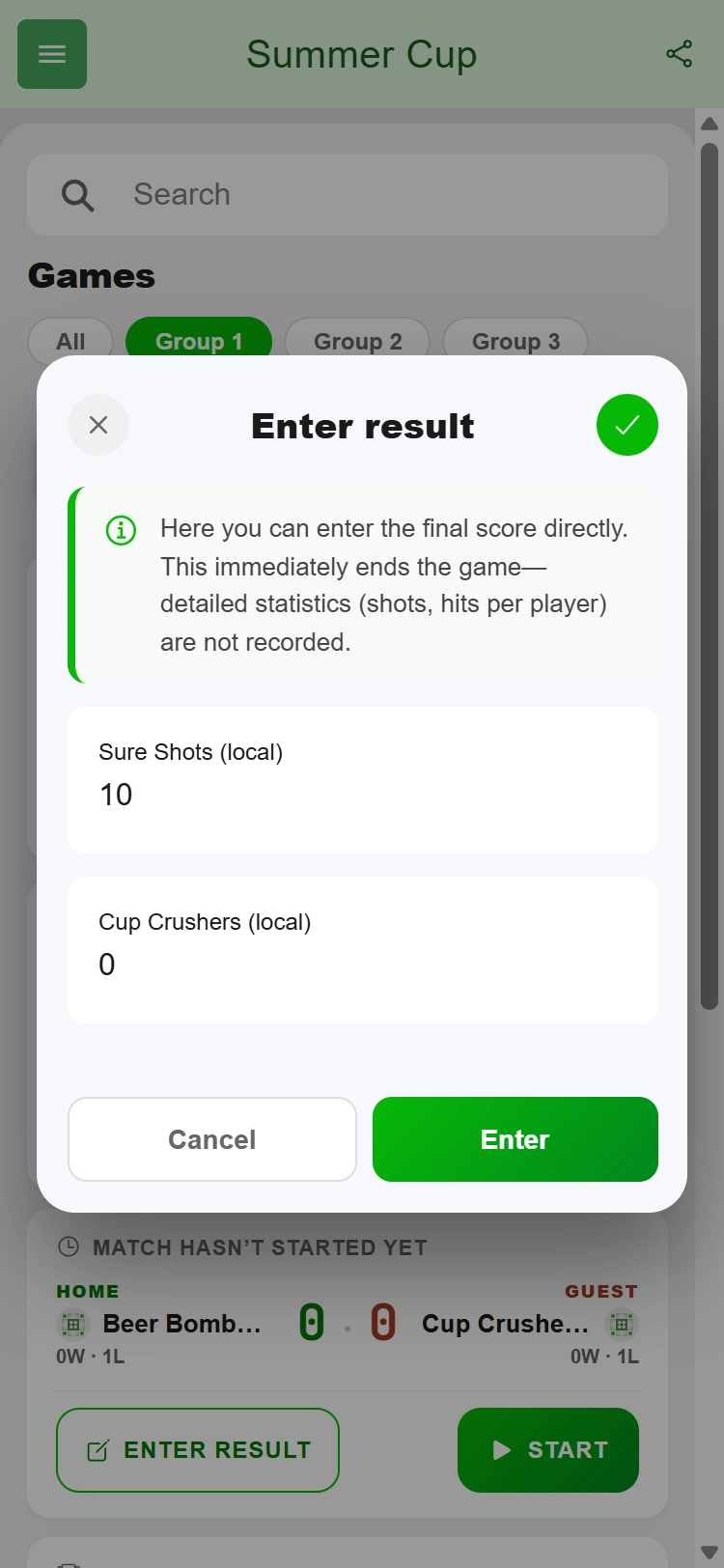
- Tap “Enter result”. The creator, referees and tournament admins can do this. Both teams of the game must already be set.
- Enter the agreed final score and confirm with “Enter”. Numbers from 0 to 99 are allowed, and a draw isn’t possible.
That ends the game and the tournament continues as normal. In a knockout, the opponent advances. The game is marked “Final score entered directly”, and no detailed stats such as throws and hits per player are recorded.
What score is fair? A proven choice is the full number of cups against 0, such as 10:0. The score counts like a normal result in the standings and cup difference, so a 10:0 adds a difference of 10 cups. Set it in advance and use the same one for every case, or you’ll skew the standings.
If a team is gone for good, enter its remaining open games the same way. In the group stage and in round robin, that’s all of its remaining games.
Special case: a team has no players left
The app handles one case by itself: when a team has no players at all left during a running tournament. In practice this only happens if the last player deletes their account. Local players you added without an account count as players, so a team made up only of local players doesn’t count as empty.
In that case:
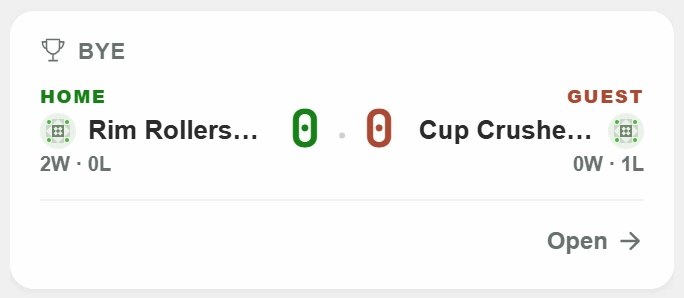
- Games of that team that haven’t started yet automatically count for the opponent. The card shows “Bye” and 0:0, with no cups on either side. The result appears for everyone immediately, without reloading.
- Games already running aren’t affected and are played to the end as normal.
- The team gets a loss with no cups in that stage’s standings, so that everyone ends up with the same number of games. This doesn’t go into career stats.
Here’s how that looks for each format:
| Format | What happens |
|---|---|
| Group stage, round robin | All open games that haven’t started are scored immediately |
| Swiss system | The current round is scored, and the team isn’t drawn in later rounds |
| Single and double elimination | The opponent advances |
| Team has already qualified for the knockout | It’s seeded as normal and loses its first knockout game without playing |
If both teams in a game are empty, the home team wins.
Which solution suits whom
If the team count won’t be settled until the night itself, Knockout only is the simplest, because any number from 4 up fits with no preparation. If every team should be guaranteed several games, choose Groups + Knockout or the Swiss system. If cancellations are common, put the waiting period in your rules ahead of time.
This article only covers awkward numbers and missing teams. For the whole process from creating a tournament to the award ceremony, see Organize a beer pong tournament, and for a rule set with a schedule you can copy, see beer pong tournament rules. For players without any account, read Play beer pong without an account.
Frequently asked questions
How many teams do I need for a beer pong tournament in BeerpongMe?
At least 4 teams, and at least 6 for a group stage. You don't need an even number or a power of two. Empty spots in the knockout bracket become byes.
Can 10 teams be split into 3 groups?
Yes. With 10 teams, BeerpongMe offers the splits 4/3/3 and 5/5 when you start the tournament. Groups may differ by one team, and the minimum size is 3 teams.
Does a bye count as a win?
It depends on the situation. In the Swiss system it does by default, with no cups, and you can turn that off. In Last One Standing it doesn't. In a knockout bracket the team simply advances.
What happens if a team doesn't show up for the tournament?
Before the start, you remove the team or swap its players. After the start, the creator, a referee or a tournament admin enters the final score on the game card with "Enter result". There's no dedicated no-show button.
Can I remove a team after the tournament has started?
No. After the start, teams and players can't be removed, so that the schedule and results stay consistent. You enter a final score for any open games of a missing team.
What happens if a team has no players left during the tournament?
Its games that haven't started yet automatically count as a bye for the opponent, 0:0 and with no cups. Games already running are played to the end as normal.